Oregon Income Tax vs California (2026): Rates, Take-Home Pay & the Sales Tax Trade-Off

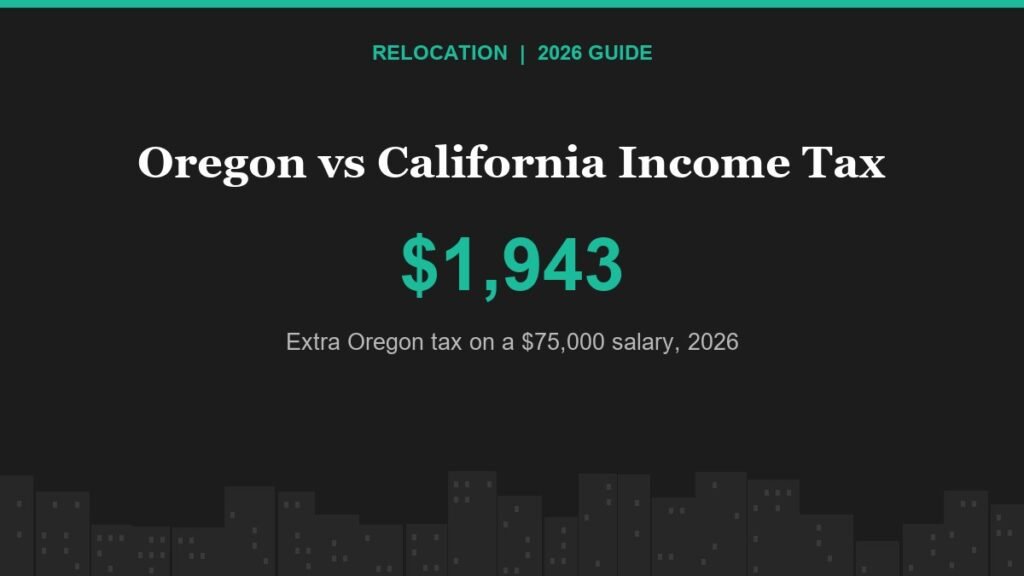
Oregon’s income tax is higher than California’s for most workers: a single filer earning $75,000 would pay about $5,583 in Oregon income and payroll taxes in 2026, compared with about $3,640 in California. But Oregon has no sales tax, while California’s statewide base sales tax rate is 7.25%, and Oregon homes cost far less. Whether you come out ahead depends on your income, your spending and where you buy.
For the full picture of life in the state, read our guide to whether Oregon is a good place to live.
2026 Income Tax Rates: Oregon vs California
Oregon has four brackets. For single filers in 2026, the Oregon Department of Revenue lists rates of 4.75% on the first $4,550 of taxable income, 6.75% up to $11,400, 8.75% up to $125,000 and 9.9% above that. California has nine brackets, from 1% to 12.3%. Its 2026 rate schedule for single filers reaches 8% at $59,498 of taxable income and 9.3% at $75,197, and the 12.3% rate starts at $768,213. California also adds a 1% mental health surcharge on income over $1 million.
| 2026, single filer | Oregon | California |
|---|---|---|
| Number of brackets | 4 | 9 |
| Lowest rate | 4.75% | 1% |
| Top rate | 9.9% (over $125,000) | 12.3% (over $768,213), plus 1% over $1 million |
| Standard deduction | $2,900 | $5,900 |
| Personal exemption credit | $260 (AGI up to $100,000) | $158 |
| Federal income tax subtraction | Up to $8,750 | None |
| Employee payroll taxes | 0.1% transit tax + 0.6% Paid Leave | 1.3% SDI, no wage cap |
| General sales tax | None | 7.25% statewide base, more locally |
What a Single Worker Would Pay
The table below estimates 2026 state income tax and state payroll deductions for a single W-2 worker with no dependents who takes the standard deduction. Federal income tax and Social Security are the same in both states, so they are left out.
| Salary | Oregon income tax | Oregon transit and Paid Leave | California income tax | California SDI | Oregon costs more by |
|---|---|---|---|---|---|
| $50,000 | $3,208 | $350 | $973 | $650 | $1,934 |
| $75,000 | $5,058 | $525 | $2,665 | $975 | $1,943 |
| $95,000 | $6,714 | $665 | $4,446 | $1,235 | $1,698 |
Our estimates use the Oregon DOR’s 2026 rate chart, $2,900 standard deduction, $260 credit and federal tax subtraction; the FTB’s 2026 schedule, $5,900 standard deduction and $158 credit; Oregon’s 0.1% statewide transit tax and 0.6% Paid Leave Oregon employee share; and California’s 1.3% SDI rate. Actual returns vary.
Oregon’s high starting rates explain the gap. California taxes the first $11,456 of taxable income at just 1%, while Oregon reaches 8.75% at $11,400. California’s SDI payroll deduction narrows the gap but does not close it at these incomes.
What About High Earners?
The gap persists at higher incomes. At a $200,000 salary, a single filer would owe at least $18,290 in Oregon income tax, transit tax and Paid Leave, even assuming the full $8,750 federal tax subtraction, which phases out at higher incomes. California income tax plus SDI would be about $16,811. California only becomes the more expensive state at very high incomes, as its 10.3%, 11.3% and 12.3% brackets, and the 1% surcharge above $1 million, take effect.
The Sales Tax Trade-Off
Oregon has no general sales tax. California’s statewide base rate is 7.25%, and local add-ons push the combined rate higher in many cities. As an illustration, a household that spends $20,000 a year on taxable goods would pay at least $1,450 in California sales tax that it would not pay in Oregon. Big purchases magnify the difference: a $40,000 car would carry at least $2,900 in California sales tax.
For many middle-income households, the sales tax savings offset part, but not all, of Oregon’s higher income tax. Heavy spenders, retirees with low taxable income and people who buy big-ticket items often come out closer to even.
Property Taxes and Housing Costs
Housing is where Oregon usually wins. The median home value is $477,600 in Oregon and $734,700 in California, according to the Census Bureau’s American Community Survey. The median annual property tax bill is $3,876 in Oregon and $5,124 in California. Both states cap assessed value growth, Oregon under Measure 50 and California under Proposition 13, so bills depend heavily on when a home was last sold or built. Electricity is cheaper too: Oregon households averaged $129.62 a month in 2024, against $160.86 in California, per the EIA.
Retirees: Social Security, Pensions and IRAs
Neither state taxes Social Security benefits. Both tax pensions, IRA withdrawals and 401(k) distributions as ordinary income, and both tax capital gains at ordinary income rates. Because Oregon’s rates start higher, a retiree with moderate pension income may pay more income tax in Oregon, but may save on sales tax and housing. Our guide to great places to retire in Oregon covers specific towns.
Moving From California to Oregon: Tax Tips
- Expect part-year returns. In the year you move, you will usually file as a part-year resident in both states. The FTB explains how it decides residency status.
- Remote work matters. If you keep a California employer after moving, ask how your wages will be sourced and withheld, and get professional advice.
- Time big sales carefully. Gains on stock or property sold while you are a California resident are taxed by California.
- Budget for higher paycheck withholding. Oregon takes more from each paycheck than California at most incomes.
To see what Oregon households actually earn, compare our report on average household income in Portland. If you are also considering Washington, which has no income tax on wages, see our guide to the pros and cons of living in Washington State.
The Bottom Line by Household Type
- Middle-income renters: Expect to pay roughly $1,934 to $1,943 more a year in Oregon income and payroll taxes at salaries of $50,000 to $75,000. Lower rents in most Oregon cities and no sales tax can make up much of that difference.
- Homebuyers: The housing gap usually dominates. Oregon’s median home value is $257,100 lower than California’s, which means a smaller mortgage and down payment.
- High earners: Oregon’s 9.9% rate applies from $125,000 of taxable income, so professionals earning a few hundred thousand dollars a year generally pay more in Oregon.
- Retirees on Social Security: Neither state taxes benefits, so savings on housing and sales tax often favor Oregon.
Frequently Asked Questions
Is Oregon income tax higher than California’s?
For most workers, yes. Oregon’s rates start at 4.75% and reach 8.75% above $11,400 of taxable income, while California starts at 1% and climbs gradually. A single filer earning $75,000 would pay about $1,943 more in Oregon income and payroll taxes. California is costlier only at very high incomes.
Is it cheaper to live in Oregon or California?
Oregon is usually cheaper overall. Its median home value is $257,100 below California’s, it has no sales tax and electricity costs less. Oregon’s higher income tax offsets part of the savings, so the result depends on your income, spending and where you buy.
Does Oregon tax Social Security?
No. Oregon does not tax Social Security benefits, and neither does California. Both states tax pensions, IRA withdrawals and 401(k) distributions as ordinary income, so retirees with large pensions should compare the income tax difference against Oregon’s lower housing costs and lack of sales tax.
This article is for general information only and is not financial, tax, legal, or real estate advice. Taxes, rates, and housing costs change and vary by address and household. Confirm current figures with the relevant agency or a licensed professional before making a decision.