Best Affordable Places to Retire in Oregon in 2026: Taxes, Healthcare & Coastal Towns

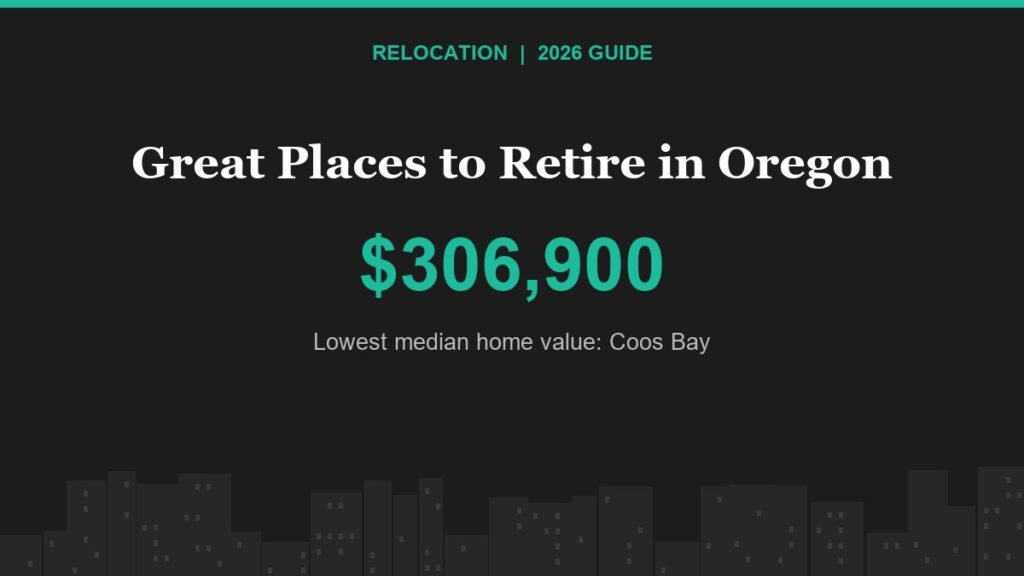
The best places to retire in Oregon balance housing costs against healthcare access, and the price range is wide: median home values run from $306,900 in Coos Bay to $718,400 in Bend. Oregon does not tax Social Security benefits and has no general sales tax, two real advantages for retirees on a fixed income.
The catches are a high state income tax on pensions and IRA withdrawals, a $1 million estate tax exemption, and natural hazards that vary sharply by region. For a wider overview of the state, see our guide to whether Oregon is a good place to live.
Oregon Retirement Taxes at a Glance
| Tax | How Oregon treats it |
|---|---|
| Social Security | Not taxed; benefits in federal income are subtracted on the Oregon return |
| Pensions, 401(k) and IRA withdrawals | Taxed as ordinary income at 4.75% to 9.9% |
| Federal pensions | Service before October 1, 1991 may be partly or fully subtracted |
| Sales tax | None |
| Estate tax | 10% to 16% above a $1 million exemption |
| Property tax | Statewide average of $17.52 per $1,000 of assessed value |
The pension tax is the big one. A single filer reaches the 8.75% bracket above $11,400 of taxable income under the 2026 withholding tables, so a sizable pension or IRA withdrawal is taxed at close to that rate. Oregon’s means-tested retirement income credit is set by ORS 316.157 to end for tax years starting on or after January 1, 2026, so do not count on it.
A 2026 bill to raise the estate tax exemption to $2.5 million, SB 1511, passed the Senate but died in a House committee. The $1 million threshold is not indexed for inflation, so a paid-off home and retirement savings can push an ordinary estate over it.
Where Oregon Retirees Live
About 19.1% of Oregonians are 65 or older, compared with 17.2% nationally. The share is far higher on the coast and in Southern Oregon:
| Place | Age 65+ | Median age | Median home value | 1BR rent | Income, householder 65+ |
|---|---|---|---|---|---|
| Florence | 43.3% | 60.8 | $358,300 | $872 | $52,964 |
| Newport | 30.6% | 51.3 | $441,400 | $1,019 | $61,755 |
| Ashland | 29.9% | 47.7 | $583,800 | $1,185 | $64,623 |
| Coos Bay | 22.5% | 44.1 | $306,900 | $905 | $50,682 |
| Grants Pass | 22.4% | 40.8 | $382,600 | $801 | $47,178 |
| Medford | 19.5% | 38.9 | $417,100 | $1,082 | $57,593 |
| Astoria | 21.3% | 40.3 | $444,800 | $789 | $47,225 |
| Eugene | 17.8% | 35.2 | $460,400 | $1,132 | $65,015 |
| Corvallis | 14.2% | 27.9 | $502,900 | $1,121 | $76,540 |
| Bend | 18.1% | 40.9 | $718,400 | $1,425 | $74,590 |
| Salem | 15.8% | 36.0 | $416,900 | $1,067 | $57,857 |
| Portland | 14.5% | 38.8 | $581,500 | $1,493 | $63,808 |
| Oregon | 19.1% | 40.4 | $477,600 | $1,301 | $61,155 |
Source: Census Bureau American Community Survey, 2020–2024. The last column is the median household income of households headed by someone 65 or older.
Great Places to Retire in Oregon
Florence: The Coast’s Retirement Town
Florence has the oldest population on this list. 43.3% of residents are 65 or older and the median age is 60.8. The median home value of $358,300 is $119,300 below the state median, and a one-bedroom rents for about $872. Florence is in Lane County, and Eugene’s larger hospitals are about 60 miles inland.
Newport: Coastal Living With More Services
Newport, on the central coast, has a 30.6% senior share and a median home value of $441,400. Like every Oregon coast town, it lies in Cascadia tsunami territory, so check the state’s tsunami inundation maps for any address.
Ashland: Culture at a Price
Ashland combines a 29.9% senior share with a theater and university town atmosphere. It is the most expensive place in Southern Oregon on this list, with a median home value of $583,800, $106,200 above the state median. Summer wildfire smoke is a real concern, and Oregon’s smoke guidance matters for anyone with heart or lung conditions.
Grants Pass and Medford: Southern Oregon Value
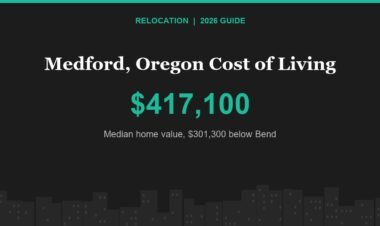
Grants Pass has a median home value of $382,600 and a one-bedroom median of $801, among the lowest on this list. Nearby Medford is a little pricier at $417,100 but is the region’s medical and shopping hub. Our guide to living in Medford covers its costs, utilities and smoke season in detail.
Coos Bay: The Most Affordable Coastal City
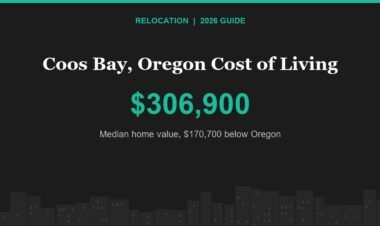
Coos Bay has the lowest median home value here at $306,900, and 22.5% of residents are 65 or older. It has a regional hospital and some of Oregon’s lower county property tax rates: the state’s 2025–26 report puts Coos County at $12.65 per $1,000 of assessed value. Read our full Coos Bay cost of living guide for more.
Eugene and Corvallis: Healthcare and University Towns
Eugene and Corvallis have younger populations, but both offer large medical centers, university classes and cultural events. Households headed by someone 65 or older have higher median incomes there, at $65,015 in Eugene and $76,540 in Corvallis, reflecting higher housing costs. Bend, at $718,400, is the priciest option, and appeals mainly to active retirees with significant savings.
Healthcare and Medicare
Access to specialists is the biggest difference between Oregon’s cities and its small towns. Coastal and rural retirees often travel to Eugene, Medford, Portland or Bend for specialist care. Oregon’s free SHIBA program offers unbiased Medicare counseling and can help you compare Medicare Advantage and supplement plans available in a specific county before you move.
Property Tax Help for Older Homeowners
Oregon’s senior and disabled property tax deferral program lets eligible homeowners aged 62 or older postpone property taxes. For 2026, household income must be under $70,000 and net worth under $500,000, excluding the home. The state pays the tax and places a lien on the home; the deferred taxes are repaid with interest, usually when the home is sold or the owner dies.
How to Choose Where to Retire in Oregon
Start with healthcare. List the specialists you see now and check drive times from each town to the nearest hospital that offers them. Then confirm that the Medicare plans you want are sold in that county, because plan networks vary from one county to the next.
Next, test the climate. Spend time in a coastal town in January, when rain and wind are at their worst, and in a Southern Oregon town in August, when heat and smoke peak. A short winter or summer rental costs far less than a move you regret.
Finally, price the full cost of a home. Ask for the actual property tax bill, a homeowners insurance quote that includes wildfire or earthquake coverage, and 12 months of utility bills. In a smaller town, also check how far you would travel for groceries, pharmacies and airports.
Natural Hazards to Check
Coastal towns face Cascadia earthquake and tsunami risk, and Southern and Central Oregon face wildfire and smoke. Before choosing a town, check hazard maps for the exact address, get insurance quotes, and keep at least two weeks of emergency supplies as Oregon officials recommend.
If you are comparing Oregon with lower-tax states, our upcoming guide to retiring in Tennessee looks at a state with no wage income tax.
Frequently Asked Questions
Is Oregon a good state to retire in?
Oregon can be a good retirement state for people living mainly on Social Security, which it does not tax, and for those who value scenery and no sales tax. It is less friendly to retirees with large pensions or IRA withdrawals, which face rates up to 9.9%, and estates above $1 million.
What is the cheapest place to retire in Oregon?
Among the cities we compared, Coos Bay has the lowest median home value at $306,900, followed by Florence at $358,300 and Grants Pass at $382,600. All three are well below Oregon’s $477,600 median. Grants Pass and Astoria also have some of the lowest one-bedroom rents.
Does Oregon tax retirement income?
Oregon does not tax Social Security benefits, but it taxes pensions, 401(k) distributions and IRA withdrawals as ordinary income at rates from 4.75% to 9.9%. Some federal pensions earned before October 1991 can be subtracted. The state’s means-tested retirement income credit is scheduled to end starting with tax year 2026.
This article is for general information only and is not financial, tax, legal, or real estate advice. Taxes, rates, and housing costs change and vary by address and household. Confirm current figures with the relevant agency or a licensed professional before making a decision.