Des Moines, IA vs Omaha, NE: Cost of Living and State Income Tax in 2026

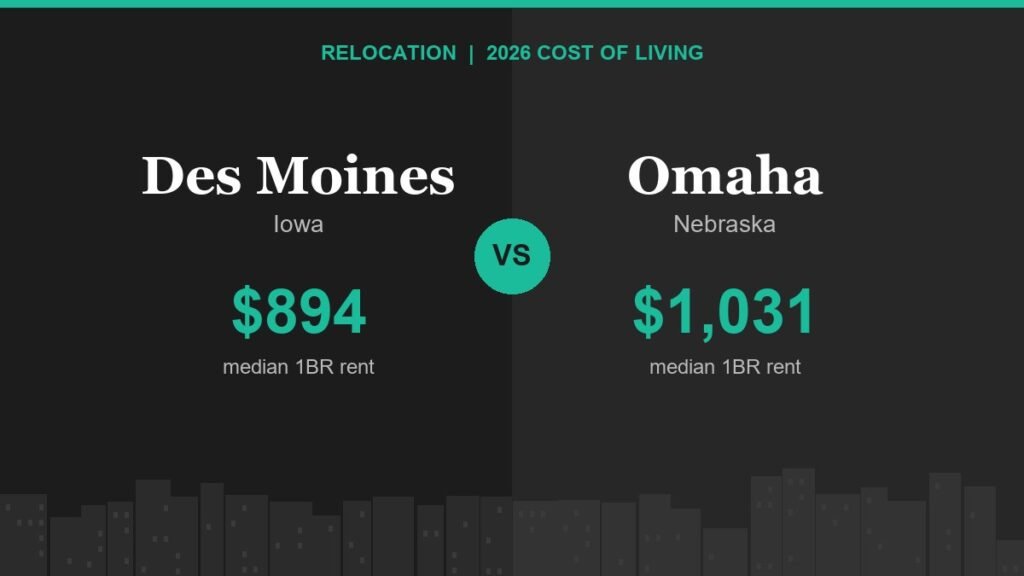
Des Moines is the cheaper city, with one-bedroom rent $137 a month below Omaha’s and a typical property tax bill $632 a year lower. Iowa also takes less income tax: a single filer earning $75,000 owes about $2,238 there and about $2,533 in Nebraska.
Omaha offers higher household income and may close part of the gap through local pay. To see how both cities compare with 21 others, read our mid-size city cost of living comparison.
Des Moines vs Omaha: Quick Cost Comparison
| Metric | Des Moines, IA | Omaha, NE | Winner / Difference |
|---|---|---|---|
| 1BR median gross rent | $894 | $1,031 | Des Moines by $137/mo |
| 3BR median gross rent | $1,414 | $1,500 | Des Moines by $86/mo |
| State income tax on $75,000 | $2,238 | $2,533 | Des Moines by $295 |
| State income tax on $110,000 | $3,568 | $4,125 | Des Moines by $557 |
| Effective property tax (implied) | 1.80% | 1.68% | Omaha by 0.11 pt |
| Median annual property tax | $3,496 | $4,128 | Des Moines by $632 |
| Median home value | $194,700 | $245,500 | Des Moines by $50,800 |
| Avg. monthly electric (state) | $111.54 | $110.28 | Nebraska by $1.26 |
| Avg. monthly internet | No official city figure | No official city figure | Compare by address |
| Mean commute | 19.5 min | 19.6 min | Des Moines by 0.1 min |
| Median household income | $65,932 | $73,201 | Omaha by $7,269 |
Housing, income, and commute figures are from the Census Bureau’s 2020–2024 American Community Survey. Gross rent includes tenant-paid utilities. Electric bills are 2024 statewide averages from the EIA.
State Income Tax: Iowa Keeps It Simple
Iowa charges a flat 3.8% on all taxable income in 2026, and its return now starts from federal taxable income. A single filer using the $16,100 federal standard deduction therefore pays 3.8% on the remainder.
Nebraska uses graduated rates of 2.46%, 3.51%, and 4.55% for 2026. Its Department of Revenue rate history lists an $8,850 standard deduction and a $176 personal exemption credit, and its 2026 tax table applies the top rate to most income in these scenarios.
| Single filer, 2026 | $75,000 salary | $110,000 salary |
|---|---|---|
| Federal income tax | $7,670 | $15,370 |
| Social Security and Medicare | $5,738 | $8,415 |
| Iowa income tax | $2,238 | $3,568 |
| Nebraska income tax | $2,533 | $4,125 |
| Take-home in Des Moines | $59,354 | $82,647 |
| Take-home in Omaha | $59,060 | $82,090 |
These estimates assume W-2 wages, no dependents, no pre-tax contributions, and the 2026 federal standard deduction of $16,100. Any Iowa personal credits would lower the Iowa figure slightly. This gap may narrow soon, because Nebraska’s statute sets a 3.99% top rate for tax years beginning in 2027.
Rent: Des Moines Leads at Every Size
Des Moines saves a one-bedroom renter $1,644 a year and a three-bedroom renter $1,032. Because Iowa’s income tax is also lower, the two advantages add together rather than offset each other:
- $75,000, one-bedroom: Des Moines is ahead by about $1,939 a year.
- $75,000, three-bedroom: Des Moines is ahead by about $1,327 a year.
- $110,000, three-bedroom: Des Moines is ahead by about $1,589 a year.
These are medians for existing tenants, so a new lease may cost more in either city. Omaha’s $7,269 higher median household income matters here. A local job that pays about 3% more in Omaha would offset the one-bedroom gap at a $75,000 salary before taxes on the raise are counted, so compare real offers.
Property Tax: High in Both, With a Twist
These are two of the highest property tax cities in our 23-city table. Dividing median tax by median home value gives an implied rate of 1.80% in Des Moines and 1.68% in Omaha, so Omaha has the slightly lower rate. Its typical bill is still $632 higher because its median home is worth $50,800 more.
At an identical $300,000 price, those implied rates suggest about $5,387 in Des Moines and $5,044 in Omaha, a difference of $342 in Omaha’s favor. Treat that as a yardstick rather than a bill, because each state calculates tax differently and each parcel has its own levy.
Both systems are changing. Iowa has replaced its homestead credit with a homestead exemption, retroactive to assessment year 2026. In Omaha, the public school board raised its levy to $1.21 per $100 of valuation for 2026–27, so a recent bill from a seller may understate what you will pay. Ask the county treasurer for the current levy on any address.
Buying a Home and Everyday Costs
On a 10% down payment, the median Des Moines home needs about $5,080 less cash at closing than the median Omaha home, and the smaller loan lowers each monthly payment. That makes Des Moines the easier first purchase, even though its tax rate is a little higher.
Electric bills are nearly equal at the state level, $111.54 in Iowa and $110.28 in Nebraska. Omaha’s combined sales tax rate is 7%. Iowa’s state rate is 6%, and a 1% local option tax applies where voters have approved one, so confirm the rate for your address. Commutes are effectively identical at about 19.5 minutes.
Which City Should You Choose?
Choose Des Moines if you want lower rent, a cheaper first home, and a simple flat income tax. Choose Omaha if a local employer pays meaningfully more, or if you plan to buy at the same price in either city. Midwest movers can also compare the Carmel and Fishers property tax guide, the Madison and Grand Rapids cost comparison, and our Fort Wayne and Grand Rapids breakdown.
More city comparisons: Huntsville vs Chattanooga cost of living, Bentonville vs Tulsa for remote workers, and Fayetteville vs Springfield housing costs.
Frequently Asked Questions
Is Des Moines or Omaha cheaper to live in?
Des Moines is cheaper for most households. Its one-bedroom rent is $137 a month lower, its three-bedroom rent is $86 lower, and its median home value is $50,800 lower. Iowa’s income tax is also lower in 2026, although Omaha’s higher household income can offset part of that difference.
Which state has lower income tax, Iowa or Nebraska?
Iowa is lower for 2026 at these incomes. A single filer owes about $2,238 on $75,000 in Iowa and about $2,533 in Nebraska. At $110,000, the figures are $3,568 and $4,125. Nebraska’s top rate is scheduled to fall to 3.99% for 2027.
Which city has higher property taxes?
Omaha’s typical annual bill is higher, at $4,128 compared with $3,496 in Des Moines. Des Moines has the slightly higher implied rate, however, at 1.80% against 1.68%. A buyer paying the same price in either city could therefore owe a little more in Des Moines.
This article is for general information only and is not financial, tax, legal, or real estate advice. Tax estimates are simplified and rates vary by address and household. Confirm current figures with the relevant agency or a licensed professional before making a decision.