Huntsville, AL vs Chattanooga, TN Cost of Living in 2026

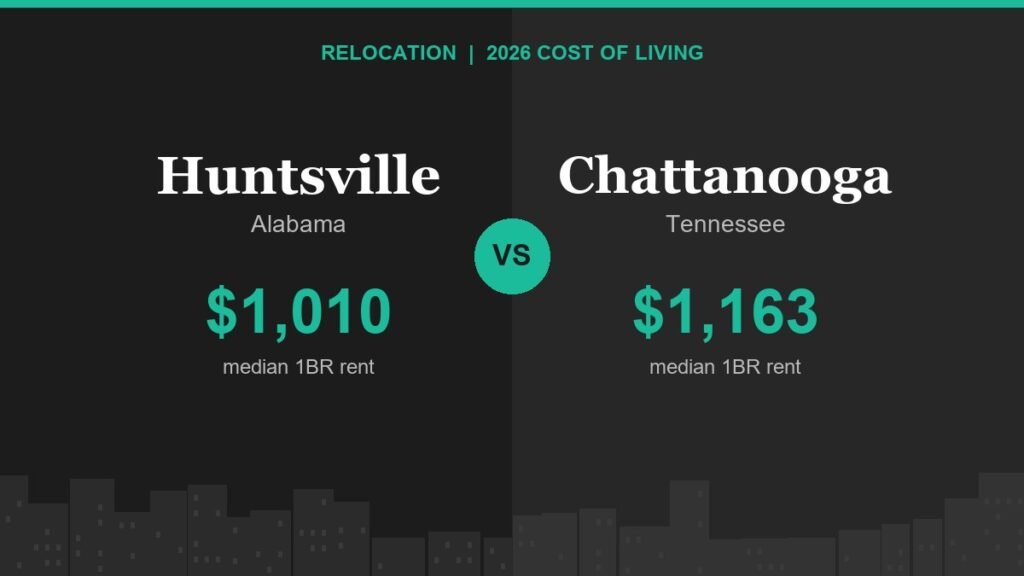
Huntsville is cheaper for housing, with one-bedroom rent $153 a month below Chattanooga’s and lower property tax, but Chattanooga usually leaves workers with more money overall. A single renter earning $75,000 comes out about $1,291 a year ahead in Chattanooga because Tennessee does not tax wages, while Alabama takes about $3,127.
The answer flips for lower earners. Below roughly $45,000, Huntsville’s rent saving on a one-bedroom is larger than Alabama’s income tax bill. For how both cities rank nationally, see our mid-size city cost of living guide.
Huntsville vs Chattanooga: Quick Cost Comparison
| Metric | Huntsville, AL | Chattanooga, TN | Winner / Difference |
|---|---|---|---|
| 1BR median gross rent | $1,010 | $1,163 | Huntsville by $153/mo |
| 3BR median gross rent | $1,366 | $1,463 | Huntsville by $97/mo |
| State income tax | 2%–5% | None | Chattanooga |
| Effective property tax (implied) | 0.46% | 0.80% | Huntsville |
| Tax on a $300,000 home, before exemptions | $1,740 | $2,584 | Huntsville by $844/yr |
| Median home value | $293,600 | $283,200 | Chattanooga by $10,400 |
| Avg. monthly electric (state) | $173.50 | $143.32 | Tennessee by $30.18 |
| Avg. monthly internet | No official city figure | No official city figure | Compare by address |
| Combined sales tax | 9.00% | 9.25% | Huntsville by 0.25 pt |
| Mean commute | 19.7 min | 18.5 min | Chattanooga by 1.2 min |
| Median household income | $74,714 | $64,523 | Huntsville by $10,191 |
Housing, income, and commute figures are from the Census Bureau’s 2020–2024 American Community Survey. Electric bills are 2024 statewide averages from the EIA. Gross rent includes tenant-paid utilities.
Take-Home Pay on a $75,000 or $110,000 Salary
Income tax is the largest difference between these cities. Tennessee has no personal income tax. Alabama taxes income at 2%, 4%, and 5%, with the 5% rate starting above $3,000 of taxable income for a single filer. Alabama softens that by allowing a deduction for federal income tax paid, and its standard deduction chart sets a $2,500 deduction for single filers at these income levels.
| Single filer, 2026 | $75,000 salary | $110,000 salary |
|---|---|---|
| Federal income tax | $7,670 | $15,370 |
| Social Security and Medicare | $5,738 | $8,415 |
| Alabama income tax | $3,127 | $4,492 |
| Take-home in Huntsville | $58,466 | $81,724 |
| Take-home in Chattanooga | $61,593 | $86,215 |
| Chattanooga advantage per month | $261 | $374 |
These estimates assume W-2 wages, the 2026 federal standard deduction of $16,100, the $1,500 Alabama personal exemption, no dependents, and no pre-tax retirement or health contributions. Both salaries fall below the 2026 Social Security wage base of $184,500. Huntsville does not appear on the Alabama League of Municipalities’ list of cities with an occupational tax, so no local wage tax is included.
Household income is a useful counterweight. Huntsville’s median household earns $10,191 more than Chattanooga’s, so a job offer there may be enough to close the tax gap. Compare actual offers: a Huntsville salary about 6% higher would roughly cancel Alabama’s income tax at these pay levels.
Rent: Huntsville Wins, Especially for Smaller Units
Huntsville’s one-bedroom advantage is worth $1,836 a year. At three bedrooms the gap narrows to $97 a month, or $1,164 a year, so the rent argument for Huntsville is strongest for singles and couples.
Set against the tax table, the renter’s result looks like this:
- $75,000, one-bedroom: Chattanooga is ahead by about $1,291 a year.
- $110,000, three-bedroom: Chattanooga is ahead by about $3,328 a year.
- $45,000, one-bedroom: The two cities are almost even, with Alabama tax of about $1,849 against $1,836 in rent savings.
If you are still deciding among Tennessee cities, our Chattanooga and Knoxville property tax comparison shows how much a move within the same no-income-tax state can change your housing bill.
Property Tax: Why Alabama Bills Are So Much Lower
Home values are close, but the tax systems are not. Alabama assesses owner-occupied homes at 10% of value, and the Madison County Tax Collector lists a total of 58 mills inside Huntsville. On a $300,000 home, that is $30,000 of assessed value and about $1,740 in tax before any homestead exemption.
Tennessee assesses residential property at 25%. Hamilton County’s 2026 rate sheet shows a combined city and county rate of $3.4457 per $100 inside Chattanooga. The same $300,000 home has $75,000 of assessed value and a bill of about $2,584, which is $844 more than in Huntsville.
Even after that, Chattanooga still comes out ahead for most working homeowners. At $75,000, the net advantage is about $2,282 a year; at $110,000, about $3,647. Retirees are different: if little of your income is taxable in Alabama, Huntsville’s lower property tax may be the bigger factor. Parts of Huntsville extend into Limestone and Morgan counties, so confirm the rate for any specific address.
Utilities and Everyday Costs
EIA’s statewide data shows Alabama households paying $173.50 a month for electricity against $143.32 in Tennessee, a gap of about $362 a year. Do not treat that as a city-to-city figure. Both Huntsville Utilities and Chattanooga’s EPB are local distributors of Tennessee Valley Authority power, so their bills are likely to be closer than the state averages suggest. Request a 12-month usage history for any home you are considering.
Groceries lean toward Alabama at the state level. Alabama’s state food tax rate is 2%, while Tennessee’s state rate on food is 4%. Local taxes apply in both places, but the state gap alone saves about $120 a year on a $6,000 grocery budget. General purchases are close, with a 4.5% Huntsville city rate inside a 9% combined rate and a 9.25% combined rate in Chattanooga.
Which City Is Better for Remote Workers?
Remote workers keep their salary when they move, which makes this comparison unusually clean. At $75,000 or more, Chattanooga’s tax advantage is hard to beat unless you find a far cheaper home in Huntsville. Anyone also considering South Carolina should read our Greenville versus Huntsville guide for remote workers, since South Carolina’s new 2026 tax rules change the math at different incomes.
Those open to the coast can compare a different set of tradeoffs in our Pensacola and Mobile homeowners insurance breakdown, where insurance can matter more than income tax.
More city comparisons: Bentonville vs Tulsa for remote workers, Fayetteville vs Springfield housing costs, and Carmel vs Fishers cost of living.
Frequently Asked Questions
Is Huntsville or Chattanooga cheaper to live in?
Huntsville is cheaper for rent and property tax, with one-bedroom rent $153 a month lower. Chattanooga is usually cheaper overall for workers earning above about $45,000 because Tennessee does not tax wages. A single person earning $75,000 keeps about $3,127 more in Chattanooga before housing differences are counted.
How much is property tax on a $300,000 home in each city?
Before exemptions, a $300,000 home inside Huntsville’s Madison County limits owes about $1,740 a year at 58 mills on a 10% assessment. The same home in Chattanooga owes about $2,584 at a combined $3.4457 per $100 on a 25% assessment, making Huntsville about $844 cheaper each year.
Does Chattanooga have a city income tax?
No. Tennessee has no personal income tax on wages, and Chattanooga does not add a local wage tax. Residents still pay federal income tax, Social Security, and Medicare. The city and county raise revenue through property tax and a combined sales tax rate of 9.25% on most general purchases.
Which city is better on a $110,000 salary?
Chattanooga has the financial edge if both jobs pay the same. A single filer keeps about $4,492 more a year there, or $374 a month. After paying about $844 more property tax on a $300,000 home, the household is still about $3,647 ahead of an identical household in Huntsville.
This article is for general information only and is not financial, tax, legal, or real estate advice. Tax estimates are simplified and rates vary by address and household. Confirm current figures with the relevant agency or a licensed professional before making a decision.