Is Oregon a Good Place to Live in 2026? True Cost, Pros, Cons & Best Cities

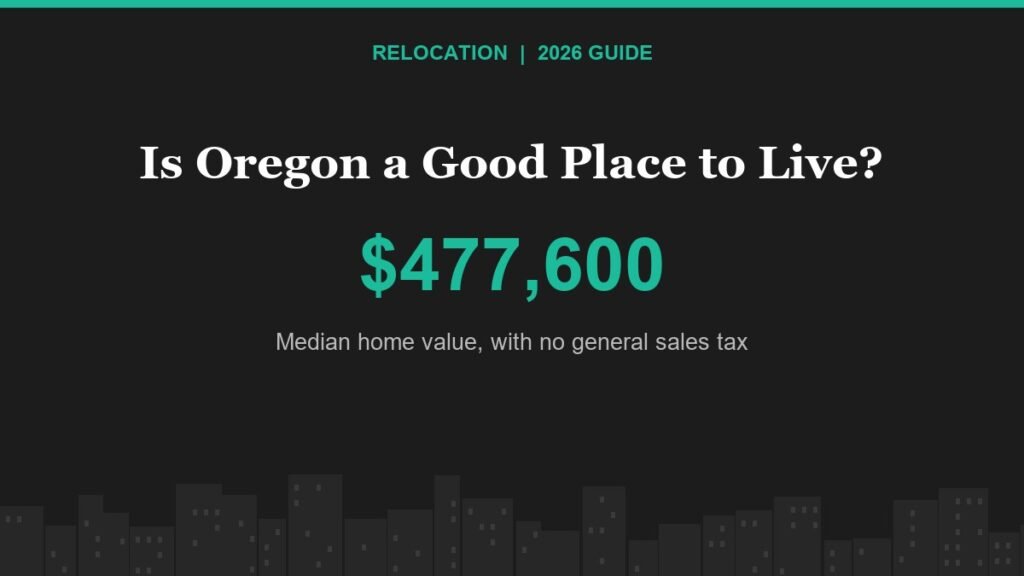
Oregon is a good place to live if you value the outdoors, shorter commutes, and no sales tax, and can afford a median home value of $477,600, which is $144,900 above the U.S. median. Its median household income of $83,011 is only $2,277 above the national figure, so housing takes a larger share of a typical budget.
The state also charges one of the country’s steeper income taxes at middle incomes, and its unemployment rate sits above the national rate. Whether Oregon works for you depends heavily on your income, your city, and how much natural hazard risk you are comfortable managing. This guide compares the real numbers, then helps you choose a place to start.
Oregon Cost of Living vs the U.S.
| Metric | Oregon | United States | Difference |
|---|---|---|---|
| Median household income | $83,011 | $80,734 | Oregon +$2,277 |
| Median gross rent | $1,525 | $1,413 | Oregon +$112/mo |
| 1BR median gross rent | $1,301 | $1,235 | Oregon +$66/mo |
| 3BR median gross rent | $1,850 | $1,584 | Oregon +$266/mo |
| Median home value | $477,600 | $332,700 | Oregon +$144,900 |
| Median annual property tax | $3,876 | $3,119 | Oregon +$757 |
| Effective property tax (implied) | 0.81% | 0.94% | Oregon lower |
| Avg. monthly electric bill | $129.62 | $142.26 | Oregon -$12.64 |
| Mean commute | 23.0 min | 26.4 min | Oregon 3.4 min shorter |
| Unemployment, October 2026 | 4.9% | 4.1% | Oregon +0.8 pt |
| General sales tax | None | Varies by state | Oregon advantage |
Housing, income, and commute figures are from the Census Bureau’s 2020–2024 American Community Survey. Gross rent includes tenant-paid utilities. Electric bills are 2024 averages from the EIA. Unemployment is from the Bureau of Labor Statistics.
The Pros of Living in Oregon
No general sales tax. The Oregon Department of Revenue confirms that the state does not have a general sales tax. On $20,000 of taxable purchases a year, a household avoids $1,400 compared with a place charging 7%. That saving is most valuable for people who buy a car, furnish a home, or spend a large share of their income.
Lower electric bills. Oregon households paid an average of $129.62 a month in 2024, or $12.64 less than the national average. Over a year, that is about $152. Mild summers west of the Cascades help, although homes in the high desert and southern valleys can use far more energy for heating and cooling.
Shorter commutes. The mean one-way trip is 23.0 minutes, against 26.4 nationally. Across 250 workdays, that saves about 28 hours a year. Smaller cities do even better, with Bend at 16.3 minutes and Coos Bay at 14.1.
Strong worker protections. Oregon’s minimum wage from July 2026 is $16.80 in the Portland metro area, $15.55 in standard counties, and $14.55 in nonurban counties. Workers also have access to Paid Leave Oregon, the state’s paid family, medical, and safe leave program.
Access to the outdoors. Few states pack a Pacific coastline, Cascade peaks, high desert, and wine country into a single drive. For many residents, that access is the main reason they accept the higher housing bill.
The Cons of Living in Oregon
Housing is expensive. The median home is worth 44% more than the national median, while household income is only 3% higher. A minimum-wage worker in the Portland metro area earns about $34,944 for a full-time year, and a median Portland one-bedroom would consume about 51% of that pay.
Income tax hits early. Oregon’s rates are 4.75%, 6.75%, 8.75%, and 9.9%. According to the state’s 2026 estimated tax instructions, the 8.75% bracket starts above just $11,400 of taxable income for a single filer, so most full-time workers pay that rate on much of their earnings.
A softer job market. Oregon’s unemployment rate was 4.9% in October 2026, compared with 4.1% nationally. Remote workers are insulated from that gap, but anyone moving without a job offer should budget for a longer search.
Natural hazards are real. State emergency officials warn that a major Cascadia Subduction Zone earthquake could strike at any time, and they urge residents to be prepared for at least two weeks without outside help. Wildfire, smoke, drought, flooding, and ice storms also affect different regions. Check hazard maps and flood coverage on any address, because standard homeowners policies generally exclude flood damage.
What You Keep on a $75,000 or $110,000 Salary
Oregon offers a federal tax subtraction of up to $8,750, a $2,900 standard deduction for single filers, and a $260 personal exemption credit for 2026. Workers also pay a 0.1% statewide transit tax and a 0.6% Paid Leave Oregon contribution.
| Single filer, 2026 | $75,000 salary | $110,000 salary |
|---|---|---|
| Federal income tax | $7,670 | $15,370 |
| Social Security and Medicare | $5,738 | $8,415 |
| Oregon income tax | $5,058 | $8,026 |
| Transit tax and Paid Leave | $525 | $770 |
| Estimated take-home | $56,009 | $77,419 |
| Per month | $4,667 | $6,452 |
These estimates assume W-2 wages, no dependents, no pre-tax contributions, and the 2026 federal standard deduction of $16,100. At $75,000, a median one-bedroom statewide would take about 28% of take-home pay. At $110,000, it falls to about 20%. Local payroll or income taxes can apply in some areas, including the Portland metro area, so check before comparing job offers.
Best Cities in Oregon, Compared
| City | Population | Median income | 1BR rent | 3BR rent | Home value | Property tax | Commute |
|---|---|---|---|---|---|---|---|
| Portland | 641,165 | $90,919 | $1,493 | $2,175 | $581,500 | $5,743 | 24.1 min |
| Salem | 178,865 | $75,487 | $1,067 | $1,909 | $416,900 | $4,007 | 22.0 min |
| Eugene | 179,591 | $66,562 | $1,132 | $1,764 | $460,400 | $4,503 | 18.4 min |
| Bend | 103,390 | $96,394 | $1,425 | $2,292 | $718,400 | $4,162 | 16.3 min |
| Medford | 86,315 | $73,230 | $1,082 | $1,713 | $417,100 | $3,236 | 16.6 min |
| Corvallis | 59,960 | $65,012 | $1,121 | $1,986 | $502,900 | $5,329 | 16.1 min |
| Coos Bay | 15,925 | $56,524 | $905 | $1,442 | $306,900 | $2,326 | 14.1 min |
Portland has the largest job market and the highest one-bedroom rent in this group. Our guide to average household income in Portland shows what salary it takes to live comfortably there.
Bend has the highest income and the highest home value, at $718,400. It suits high earners and remote workers, and our Bend cost of living breakdown shows how far a budget really goes.
Eugene pairs a university economy with a 18.4-minute commute and a $1,132 one-bedroom. See our Eugene monthly budget guide for rent, utilities, and everyday costs.
Medford offers a median home about $301,300 cheaper than Bend’s, along with a drier southern climate. Our Medford cost of living guide weighs whether it is a good fit.
Coos Bay is the most affordable city here, with a $905 one-bedroom and a $306,900 median home. Read our guide to living in Coos Bay before you trade lower prices for a smaller job market and coastal exposure.
Salem and Corvallis are worth a look too. Salem offers state government employment and a $416,900 median home, while Corvallis has a university economy, a short commute, and a tight rental market.
What a Monthly Budget Looks Like in Each City
Citywide medians are easier to use when they are turned into a real budget. The table below starts with the estimated $4,667 monthly take-home pay of a single worker earning $75,000, then subtracts a median one-bedroom rent. The last two columns show the gross annual income needed to keep rent at 30% of pay, a common affordability guideline.
| City | Monthly take-home | 1BR rent | Left after rent | Rent share | Income for 1BR at 30% | Income for 3BR at 30% |
|---|---|---|---|---|---|---|
| Portland | $4,667 | $1,493 | $3,174 | 32% | $59,720 | $87,000 |
| Bend | $4,667 | $1,425 | $3,242 | 31% | $57,000 | $91,680 |
| Eugene | $4,667 | $1,132 | $3,535 | 24% | $45,280 | $70,560 |
| Salem | $4,667 | $1,067 | $3,600 | 23% | $42,680 | $76,360 |
| Medford | $4,667 | $1,082 | $3,585 | 23% | $43,280 | $68,520 |
| Coos Bay | $4,667 | $905 | $3,762 | 19% | $36,200 | $57,680 |
The spread is meaningful. A worker in Coos Bay keeps $588 more each month after rent than the same worker in Portland, or $7,056 a year. The comparison changes for families. A median three-bedroom in Bend requires about $91,680 of gross income under the 30% guideline, which is only a little below the city’s $96,394 median household income.
Remember that these are medians for existing tenants, including people who have held the same lease for years. New listings often cost more, particularly in Bend and central Portland. Because gross rent already includes tenant-paid utilities, do not add a full electric bill on top of these numbers when you estimate a renter’s budget.
Renting vs Buying in Oregon
The down payment is often the first obstacle. At the statewide median value, a 10% down payment comes to $47,760, compared with $33,270 at the national median. In Bend, the same 10% is $71,840, while in Coos Bay it is $30,690. Closing costs, moving expenses, and an emergency fund come on top of that.
Ownership rates show how the market splits. About 63.3% of Oregon households own their home, close to the national 65.2%. In Portland the figure is 52.0%, in Eugene it is 47.9%, and in the college town of Corvallis it is just 41.7%, so renters have plenty of company in those cities. If you are new to the state, renting for your first year lets you learn neighborhoods, commute routes, smoke patterns, and winter conditions before you commit to a mortgage.
Oregon’s Regions at a Glance
Oregon is not one climate or one lifestyle, and choosing the right region can matter as much as choosing the right city.
- Willamette Valley: Home to Portland, Salem, Corvallis, and Eugene, with most of the state’s jobs and universities. Expect wet, gray winters and warm, dry summers.
- Central Oregon: Bend and its neighbors offer high-desert sunshine, cold nights, and year-round recreation, along with some of the state’s highest home prices.
- Southern Oregon: The Rogue Valley around Medford is drier and hotter in summer. Wildfire smoke is an important consideration here.
- The Coast: Towns such as Coos Bay offer lower prices and ocean access, but fewer jobs, frequent storms, and tsunami zones in low-lying areas.
- Eastern Oregon: Rural, spacious, and generally less expensive, with long distances between services and major hospitals.
How Oregon Property Taxes Work
Oregon’s system surprises many newcomers. Measure 5 limits most taxes to $5 per $1,000 of real market value for schools and $10 for other government, with bonds outside those limits. Measure 50 then generally limits growth in maximum assessed value to 3% a year, with exceptions for new construction and major improvements.
Because assessed value can sit well below market value, two similar homes on one street can have very different bills. Oregon’s implied statewide rate of 0.81% is below the national 0.94%, but the typical bill is still $757 higher because homes cost more. Always look up the actual tax record for the property you plan to buy.
Who Should Move to Oregon?
- A good fit: remote workers with outside salaries, outdoor-focused households, higher earners who buy large taxable items, and people prioritizing short commutes.
- A harder fit: first-time buyers on one modest income, job seekers without an offer, and anyone unwilling to prepare for earthquakes, smoke, or winter storms.
Before committing, rent for a few months if you can, spend time there in both winter and fire season, get an insurance quote on a real address, and run your own take-home pay. Build a two-week emergency kit soon after you arrive, as Oregon’s emergency planning guide recommends, and learn whether your neighborhood sits in a wildfire, flood, or tsunami hazard area before you sign a lease or make an offer.
Frequently Asked Questions
Is Oregon a good place to live?
Oregon can be an excellent place to live if you value nature, shorter commutes, and no sales tax. The tradeoffs are a $477,600 median home value, relatively high income tax, and a 4.9% unemployment rate. It generally works best for households with solid incomes or remote jobs.
What is the cost of living in Oregon?
Oregon costs more than the national average for housing. Median gross rent is $1,525 a month against $1,413 nationally, and the median home value is $477,600 against $332,700. Electric bills average $129.62 a month, and there is no general state sales tax on purchases.
Does Oregon have a state income tax?
Yes. Oregon’s 2026 rates are 4.75%, 6.75%, 8.75%, and 9.9%. A single filer earning $75,000 would owe about $5,058 under our estimate, plus about $525 in transit tax and Paid Leave contributions. The absence of a sales tax offsets part of that cost for many households.
What is the most affordable city in Oregon?
Among the seven cities we compared, Coos Bay is the most affordable, with a $905 median one-bedroom rent and a $306,900 median home value. Its median household income of $56,524 is also the lowest in the group, so check local job options first.
This article is for general information only and is not financial, tax, legal, or real estate advice. Taxes, rates, and housing costs change and vary by address and household. Confirm current figures with the relevant agency or a licensed professional before making a decision.