Is Portland, Oregon Safe in 2026? Crime Statistics, Safest Areas & What to Avoid

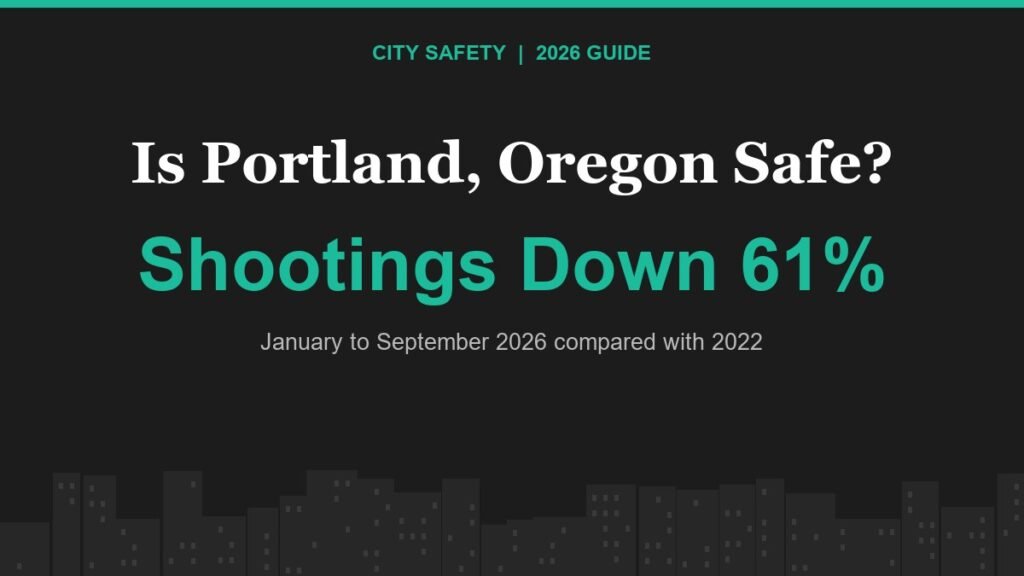
Portland is safer than it was a few years ago, but its violent crime rate is still about twice the national rate. The FBI’s estimate of roughly 4,400 violent crimes in 2025 works out to about 697 per 100,000 residents, compared with a U.S. rate of 335.2. At the same time, Portland recorded 389 shooting incidents through September 2026, down 9.7% from a year earlier and 61.2% from the same period in 2022.
For most residents and visitors, the crime most likely to affect daily life is theft, especially from or of a vehicle. Serious violence is concentrated in particular places and circumstances, so your block, routine, and precautions matter more than a citywide average.
Portland Crime Statistics at a Glance
| Measure | Portland | Comparison | What it means |
|---|---|---|---|
| Violent crimes, 2025 (estimate) | About 4,400 | Oregon: 13,300 | About one-third of the state’s total |
| Violent crime rate per 100,000 | About 697 | U.S.: 335.2 | About 2.1 times the national rate |
| Homicides, 2025 | 52 | 24% fewer than 2024 | Large one-year decline |
| Homicide rate per 100,000 | About 8.2 | U.S.: 4.3 | About 1.9 times the national rate |
| Shooting incidents, Jan–Sept 2026 | 389 | Down 9.7% from 2025 | Continuing a multi-year decline |
| Property crimes, 2025 | About 2,600 fewer than 2024 | Oregon down 12.1% | Improving, but still common |
| Motor vehicle thefts, 2025 | Nearly 1,500 fewer than 2024 | U.S. rate: 207.9 per 100,000 | A key risk for car owners |
Portland and Oregon 2025 counts are FBI figures reported by KATU. Portland’s rates are our calculation using the roughly 631,000 residents cited in that report. National rates are 2025 estimates from the Bureau of Justice Statistics. Because sources and methods differ, treat rate comparisons as approximate.
Is Crime in Portland Going Up or Down?
The clearest recent trend is down. Portland police recorded 389 shooting incidents through September 2026. That total was 9.7% below the same period in 2025, 40% below 2024, 50.8% below 2023, and 61.2% below 2022.
| January–September | Approximate shooting incidents | 2026 change from that year |
|---|---|---|
| 2022 | 1,003 | -61.2% |
| 2023 | 791 | -50.8% |
| 2024 | 648 | -40.0% |
| 2025 | 431 | -9.7% |
| 2026 | 389 | Current year |
Earlier-year totals are calculated from the published percentage changes and rounded.
Homicides moved in the same direction. The Portland Police Bureau’s 2025 annual report counted 52 homicides, which the chief described as a 24% decrease from 2024. The improvement also extended statewide. According to the FBI figures reported by KATU, Oregon’s violent crime fell an estimated 7.9% in 2025, murder fell 24.4%, property crime fell 12.1%, and burglaries fell 20.4%. Oregon then recorded about 16% fewer violent crimes from January through August 2026 than in the same months of 2025.
Part of this reflects a wider national decline. The Bureau of Justice Statistics estimates that U.S. violent crime fell 11% and property crime fell 13% from 2024 to 2025. Portland’s progress is real, but it started from an unusually high level, which is why its rate can be falling and still remain well above the national figure.
Portland vs the Rest of Oregon
Portland accounts for a disproportionate share of the state’s violent crime. Using the 2025 FBI counts, the city had about 33% of Oregon’s violent crimes with about 15% of its residents. Oregon’s overall violent crime rate works out to about 311 per 100,000, which is below the national 335.2. Excluding Portland, the rate for the rest of the state falls to about 245.
That gap matters if you are choosing where to settle. A household that wants Oregon’s lifestyle but is concerned about violent crime has many other communities to consider, although smaller cities can have their own property crime problems and fewer police resources. Compare each city on its own data instead of assuming that smaller automatically means safer.
How to Read Crime Rates Without Being Misled
A rate per 100,000 residents is the fairest quick comparison, but it has limits. It counts crimes against a city’s residential population, so downtown cores with many commuters, shoppers, and tourists can look worse than they would if every visitor were counted. It also cannot tell you whether an offense was random or involved people who knew each other.
Reporting differences matter as well. Agencies classify some incidents differently, not every crime is reported to police, and recent figures are often revised. A rate of about 697 does not mean you have a fixed chance of becoming a victim. Your exposure depends on where you live, when you travel, and what you do. Use the citywide number to understand the overall picture, then rely on address-level data for a real decision.
What Crime Are You Most Likely to Encounter?
Most crime reported in Portland does not involve a direct attack on a person. One published analysis put total reports to the Portland Police Bureau at around 58,200 in 2025, with 10,510 classified as crimes against people. That means roughly 18% of reports fell into the person-crime category, and the large majority involved property or other offenses.
Vehicle crime deserves the most attention. Portland reported nearly 1,500 fewer motor vehicle thefts in 2025 than in 2024, which is meaningful progress, yet car theft and break-ins remain among the most practical concerns for residents and visitors. Never leave bags, electronics, or documents visible, and treat street parking as exposed.
Other property crime includes package theft, bicycle theft, burglary, and vandalism. Oregon’s statewide property crime rate works out to about 2,120 per 100,000 residents using the 2025 FBI count, above the national 1,616.1. Renters should carry renters insurance, and bike owners should register their bikes and use a strong lock.
Violent crime is less common but more serious. Much of it involves people who know each other, disputes, or specific locations and times. That does not eliminate the risk of random violence, but it does explain why a typical resident’s experience can differ sharply from the citywide rate.
Portland’s Safest Areas and Higher-Crime Areas
We do not publish a definitive “safest neighborhoods” ranking because the full neighborhood-level police dataset was not accessible for this review, and rankings built on partial data can mislead. What we can show is the most recent published shooting data for several neighborhoods.
| Neighborhood | Reported shootings, Sept 2025–Sept 2026 |
|---|---|
| Powellhurst-Gilbert | 35 |
| Lents | 34 |
| Hazelwood | 33 |
| St. Johns | 23 |
| Old Town | 19 |
Source: Portland Police Bureau data as reported by KATU. Only these five neighborhoods were listed, and the counts are not adjusted for population, so they should not be read as a complete ranking.
The list offers a useful correction to a common assumption. Old Town has a reputation as Portland’s roughest district, yet it recorded fewer shootings than three outer East Portland neighborhoods during this period. That does not make Old Town low-risk, since visible disorder, drug activity, and property crime can still shape the experience there. It does show why a reputation is a poor substitute for current data.
To evaluate a specific address, use this process:
- Open the official dashboard. The Portland Police Bureau’s Reported Crime Data page provides monthly statistics and trends, updated roughly 30 days after each month ends.
- Compare categories separately. A busy retail district can show high theft and low violence, while a quiet residential area may show the reverse.
- Look at 12 months or more. One unusual month can distort a small neighborhood’s numbers.
- Visit at different times. Walk the block on a weekday morning, a weekend night, and after dark.
- Ask people who live there. Neighbors can tell you about parking, package theft, and problem properties that statistics may miss.
Is Downtown Portland Safe?
Downtown is generally busiest and most comfortable during the day and around major events, hotels, offices, and cultural venues. Some blocks feel very different after businesses close, and visible homelessness or drug use can be unsettling even when no crime occurs.
Visitors can lower their risk with basic habits: stay on well-lit streets with foot traffic, plan your route before leaving a venue, use a rideshare late at night if you are unsure, keep your phone out of sight near curbs and transit stops, and never leave anything in a parked car. If a situation feels wrong, move toward an open business or a group of people.
Is Portland Safe for Families and New Residents?
Many families live in Portland without ever experiencing serious crime, but neighborhood choice matters. Before signing a lease or making an offer, review 12 months of local crime data, check the walking route to school and transit, ask about secured parking, and price renters or homeowners insurance on the exact address.
Crime is also only one part of personal safety in Oregon. State emergency officials urge households to prepare for earthquakes, wildfire smoke, and winter storms, and to keep at least two weeks of supplies on hand. New residents should build that into their move-in checklist.
How Portland Compares With Other Northwest Cities
A citywide comparison is most useful when you look at several nearby options using the same categories. Our guide to crime rates and safest neighborhoods in Tacoma covers Washington’s port city, while the Olympia safety guide looks at a smaller state capital. North of Seattle, our Everett crime statistics breakdown shows how another working waterfront city compares.
Staying in Oregon? Read our Salem crime rate and neighborhood guide if you are considering the state capital, or the Medford safety guide for a smaller southern Oregon option. Be careful when comparing rates between agencies, since reporting practices and city boundaries can change the result.
How to Stay Safe in Portland
- Protect your car. Park in a garage or a well-lit area, use a steering lock if your model is frequently targeted, and leave nothing visible.
- Secure deliveries. Use a lockbox, parcel locker, or scheduled delivery.
- Lock your bike properly. Use a strong U-lock through the frame and keep a record of the serial number.
- Stay aware on transit. Keep valuables out of sight and sit near the operator or other riders at night.
- Report what happens. Call 911 for emergencies and use the city’s non-emergency options for other incidents, because reports help police track patterns.
Frequently Asked Questions
Is Portland, Oregon safe to live in?
Portland can be a safe place to live, particularly with careful neighborhood selection, but its violent crime rate is about twice the national rate. Shootings and homicides have fallen substantially since 2022. Property crime, especially vehicle theft and break-ins, is the risk most residents should plan around and take practical steps to reduce.
What is the crime rate in Portland in 2026?
Full-year 2026 rates are not available yet. Portland recorded about 4,400 violent crimes in 2025, or roughly 697 per 100,000 residents. Through September 2026, police logged 389 shooting incidents, down 9.7% from the same period in 2025. Check the police bureau’s monthly dashboard for the latest figures.
Is downtown Portland safe at night?
It depends on the block and the time. Areas near open venues, hotels, and foot traffic tend to feel safer, while quiet blocks can feel uncomfortable after closing. Plan your route, avoid walking alone through empty areas, use a rideshare if unsure, and never leave belongings visible inside a parked car.
What is the safest part of Portland?
We do not name one safest neighborhood because complete, population-adjusted neighborhood data was not available for this review. Use the Portland Police Bureau’s crime dashboard to compare at least 12 months of data for an address, then visit the area at several times of day before making a decision.
This article is for general information only and is not legal or security advice. Crime data is subject to revision, reporting practices vary by agency, and past statistics cannot predict your personal risk. In an emergency, call 911.