Savannah, GA vs Charleston, SC: Cost of Living and Flood Insurance in 2026

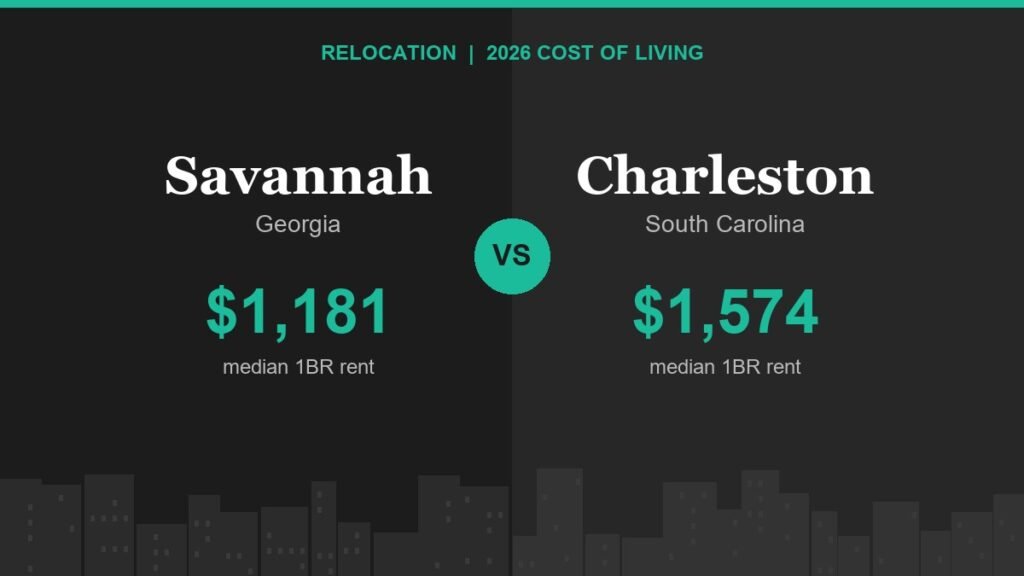
Savannah is far cheaper than Charleston, with one-bedroom rent $393 a month lower and a median home value $260,800 lower. State income tax is nearly even: a single filer earning $110,000 owes about $4,741 in Georgia and $4,765 in South Carolina, a difference of only $25.
Charleston has the lower property tax rate and much higher household income. In both cities, flood risk can change a budget more than any tax. For the national picture, see our cost of living guide to mid-size cities.
Savannah vs Charleston: Quick Cost Comparison
| Metric | Savannah, GA | Charleston, SC | Winner / Difference |
|---|---|---|---|
| 1BR median gross rent | $1,181 | $1,574 | Savannah by $393/mo |
| 3BR median gross rent | $1,534 | $2,213 | Savannah by $679/mo |
| State income tax on $75,000 | $2,994 | $2,657 | Charleston by $337 |
| State income tax on $110,000 | $4,741 | $4,765 | Savannah by $25 |
| Effective property tax (implied) | 0.82% | 0.43% | Charleston |
| Median annual property tax | $2,040 | $2,214 | Savannah by $174 |
| Median home value | $248,900 | $509,700 | Savannah by $260,800 |
| Flood insurance | Quote by address | Quote by address | No official city figure |
| Combined sales tax | 7% | 9% | Savannah by 2 pts |
| Avg. monthly electric (state) | $151.25 | $149.51 | South Carolina by $1.74 |
| Avg. monthly internet | No official city figure | No official city figure | Compare by address |
| Mean commute | 20.7 min | 24.2 min | Savannah by 3.5 min |
| Median household income | $57,137 | $92,414 | Charleston by $35,277 |
Housing, income, and commute figures are from the Census Bureau’s 2020–2024 American Community Survey. Gross rent includes tenant-paid utilities. Electric bills are 2024 statewide averages from the EIA.
Take-Home Pay: Close Enough to Ignore
Both states changed their income tax in 2026. Georgia’s HB 463 lowered the flat rate to 4.99%, retroactive to January 1, and the state’s Department of Revenue lists a $15,000 standard deduction for single filers. The law is facing a court challenge, so check for updates before filing. South Carolina’s H.4216 uses 1.99% below $30,000 and 5.21% minus $966 above it, with a $15,000 deduction that phases out between $40,000 and $95,000 of federal adjusted gross income.
| Single filer, 2026 | $75,000 salary | $110,000 salary |
|---|---|---|
| Federal income tax | $7,670 | $15,370 |
| Social Security and Medicare | $5,738 | $8,415 |
| Georgia income tax | $2,994 | $4,741 |
| South Carolina income tax | $2,657 | $4,765 |
| Take-home in Savannah | $58,599 | $81,475 |
| Take-home in Charleston | $58,935 | $81,450 |
These estimates assume W-2 wages, no dependents, no pre-tax contributions, and the 2026 federal standard deduction of $16,100. Neither city is treated as levying a local wage tax. For most households, income tax should not decide this comparison.
Rent: Savannah’s Decisive Advantage
Charleston has the highest one-bedroom and three-bedroom medians of the 23 cities we track. Choosing Savannah saves $4,716 a year on a one-bedroom and $8,148 on a three-bedroom:
- $75,000, one-bedroom: Savannah is ahead by about $4,379 a year.
- $75,000, three-bedroom: Savannah is ahead by about $7,811 a year.
- $110,000, three-bedroom: Savannah is ahead by about $8,173 a year.
These medians include long-term tenants, and tourist-area rentals in either city can run well above them. Renters should still price contents coverage, because a landlord’s policy generally does not protect a tenant’s belongings.
Property Tax: Charleston’s Low Rate Has a Catch
Charleston’s implied rate of 0.43% is the lowest in our table, and Savannah’s is 0.82%. South Carolina assesses an owner-occupied primary home at 4%. Georgia assesses property at 40% of fair market value, with a Chatham County homestead exemption that takes $12,000 off the assessed value for county taxes and $2,000 for school and state taxes. Savannah’s own city rate is only one part of the combined bill.
At an identical $300,000 price, the implied rates suggest about $2,459 a year in Savannah and $1,303 in Charleston, a $1,156 advantage for Charleston. The catch is that few buyers will find the same home at the same price. Charleston’s median home costs more than twice as much, so its typical owner still pays $174 more per year despite the lower rate.
The 4% rate applies only to a legal residence. A second home or rental in South Carolina is assessed at a higher ratio, which can raise the bill sharply for part-time residents and investors.
Flood Insurance: Check Before You Offer
We could not find an official citywide average flood premium, and an average would mean little in two low-lying coastal cities where risk changes from street to street. Use this process on every address instead:
- Look up the flood zone. FEMA’s National Flood Hazard Layer shows the official map for a property.
- Get a written quote before your inspection period ends. FEMA notes that most homeowners insurance does not cover flood damage and that National Flood Insurance Program policies typically have a 30-day waiting period.
- Check the coverage limit. NFIP policies on one- to four-family homes cap building coverage at $250,000 and contents at $100,000. That matters in Charleston, where the median home is worth far more than the building limit.
- Price wind separately. Ask whether your homeowners policy has a percentage hurricane deductible.
For a similar exercise on the Gulf Coast, see our Pensacola and Mobile homeowners insurance comparison.
Everyday Costs and the Final Call
Savannah’s 7% sales tax is two points below Charleston County’s 9%, saving $200 on every $10,000 of taxable purchases. Electric bills are almost identical at the state level, and Savannah’s mean commute is 3.5 minutes shorter each way, or about 29 hours over 250 workdays.
Choose Savannah if you want lower rent, a much cheaper home, and lower sales tax. Choose Charleston if a local job pays enough to cover the premium, since its median household earns $35,277 more. Those considering an inland South Carolina option can read our Greenville and Huntsville remote work comparison, and buyers weighing another state-line tax decision can use the Spokane and Coeur d’Alene guide.
More city comparisons: Huntsville vs Chattanooga cost of living, Chattanooga vs Knoxville property taxes, and Bentonville vs Tulsa for remote workers.
Frequently Asked Questions
Is Savannah or Charleston cheaper to live in?
Savannah is much cheaper. Its one-bedroom rent is $393 a month lower, its three-bedroom rent is $679 lower, and its median home value is $260,800 lower. State income taxes are close, so housing drives the result. Charleston’s higher local incomes can offset part of the difference for people with local jobs.
Which city has lower property taxes?
Charleston has the lower implied rate, at 0.43% against 0.82% in Savannah, because South Carolina assesses primary homes at 4%. Savannah’s typical bill is still $174 lower because its homes cost far less. Non-primary homes in South Carolina are assessed at a higher ratio and pay considerably more.
Do I need flood insurance in Savannah or Charleston?
Your lender may require it in a high-risk flood zone, and it is worth pricing even outside one. Standard homeowners policies usually exclude flood damage. Check the address on FEMA’s flood map, request a quote before your inspection period ends, and remember that NFIP coverage typically has a 30-day waiting period.
This article is for general information only and is not financial, tax, legal, insurance, or real estate advice. Estimates are simplified and rates vary by address and household. Confirm current figures with the relevant agency, an insurer, or a licensed professional before making a decision.